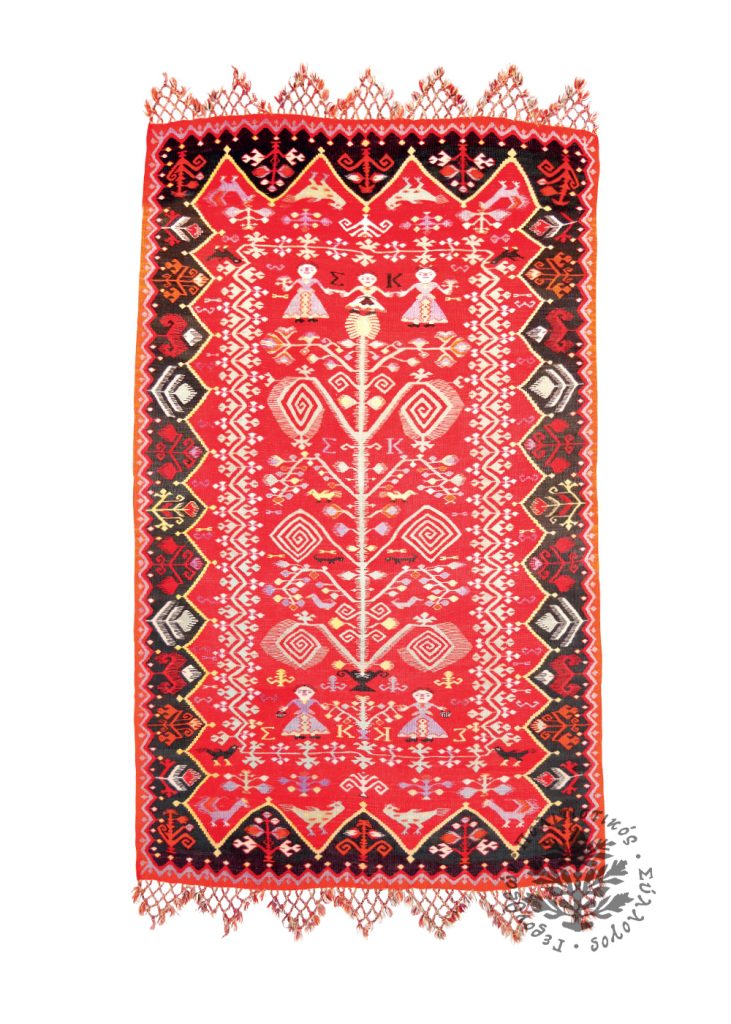
Geraki holds a special place within the weaving communities of Greece. Archaeological finds, material evidence, and written sources demonstrate that women of Geraki have been engaged in weaving from the Bronze Age through the Middle Ages and into the modern era. The continuity of weaving practices over the centuries sets this village apart from all others. Weaving was primarily a domestic activity, as ancient finds show, but medieval remains in Geraki also revealed an organized workshop. Indeed, in the modern period, the village’s weavers have produced kilims both for domestic and commercial use. Geraki was particularly known as a production site of dowry kilims. Dowry kilims from Geraki are found throughout Laconia, as well as in Athens, Patras, Dimitsana, and elsewhere. Historically, families gave kilims to churches as votive offerings to seek divine assistance at times of need. Kilims from Geraki are housed in churches and monasteries as well as in private collections in Greece and abroad. Works woven by the hands of Geraki weavers are a source of enormous pride to many families. Many kilims remain within families for generations, either exhibited in the home or protected in trunks.
The women of Geraki have long been recognized for their skilled weaving. In the census of 1946 in Geraki, more than 200 active looms were recorded in the village, the most significant number in Laconia. According to local sources, a Tree of Life kilim woven by an unmarried woman named Eleni Morpha won a merit award from an international jury at the Vienna World’s Fair of 1873. The work of Eleni Koutsovasili and Diamanto Gianne was recognized at the Eighth International Exhibition in Thessaloniki in 1933. Yet another award was garnered by Penelope Zervou for two kilims, according to her family, a Tree of Life with two peacocks and a woven icon of the Virgin Hodegetria. Recognizing the importance of the village’s long history of weaving, in 2019, the textile art of Geraki was inscribed in the Greek National Intangible Cultural Heritage Index.
The designs of the kilims carry symbolic meaning. Woven trees, flowers, animals, and figures engaged in olive picking, dancing, or playing music depict the weaver’s daily environment but also express wishes for health and happiness. Traditional patterns include the Tree of Life, Sun, Calligraphy, Margarita, Byzantino, Tsakoniko, and Plakaki. Until recently, weavers spun yarn from the wool of sheep and goats raised in the surrounding area and created natural dyes using plants from Mount Parnon.